


We recognize Building Information Modeling (BIM) as a transformative digital process that revolutionizes infrastructure development. BIM for infrastructure projects integrates intelligent 3D modeling with data-rich environments, enabling precise planning, design, construction, and management of roads, bridges, and smart cities. We leverage BIM to deliver efficient, sustainable, and resilient infrastructure that meets modern urban demands.
Understanding BIM in Infrastructure Context
We define BIM as an intelligent model-based approach that provides architecture, engineering, and construction professionals with insights and tools to plan, design, construct, and manage infrastructure effectively. Unlike traditional 2D drawings, BIM for infrastructure projects creates comprehensive digital representations incorporating geometry, spatial relationships, geographic information, quantities, and properties of components.
In roads and bridges, BIM extends beyond buildings to horizontal assets, addressing linear characteristics, extensibility, and integration with terrain, utilities, and environmental factors. We apply BIM across the full lifecycle—from conceptual planning to operation and maintenance—ensuring data continuity and collaboration among stakeholders.
BIM for infrastructure projects aligns with international standards like ISO 19650, which outlines information management principles using BIM. This framework ensures organized digitization of information for civil engineering works, promoting interoperability, security, and efficiency in roads, bridges, and smart cities.
Key Benefits of BIM for Roads and Highways
We harness BIM to optimize road design and construction, delivering superior outcomes in efficiency and sustainability. BIM for infrastructure projects enables precise corridor modeling, integrating horizontal and vertical alignments with real-time terrain data for highways spanning diverse landscapes.
- Enhanced Design Accuracy: We generate detailed corridor models in tools like Autodesk Civil 3D and Bentley OpenRoads, incorporating alignment geometry, superelevation, cross-sections, earthworks volumes, pavement layers, and drainage patterns. This parametric approach automatically updates designs with changes, reducing errors in topography modeling, site grading, and cut-fill balances. Integration with GIS data ensures accurate representation of existing conditions, minimizing survey discrepancies and enabling optimized route selection for reduced environmental disruption.
- Clash Detection and Coordination: BIM models identify conflicts between road elements, underground utilities, overhead structures, and existing infrastructure early in the design phase using automated clash detection in Navisworks or Bentley Navigator. This prevents costly rework during construction, as seen in projects where early detection saved millions by resolving utility relocations before excavation.
- Quantity Takeoff and Cost Estimation: Precise automated calculations from BIM models provide accurate material quantities for asphalt, concrete, aggregates, and reinforcement, enabling reliable 5D costing and budgeting. Integration with estimation software supports dynamic updates, reducing overruns in highways and interchanges, with reported savings up to 35% in design expenditure.
- Traffic Simulation and Safety Analysis: We integrate BIM with tools like VISSIM or Synchro for evaluating traffic flows, intersection performance, congestion points, sight distances, and safety features such as barriers and signage. This optimizes layouts for capacity, reduces accident risks, and supports intelligent transportation systems in smart cities.
- Environmental Impact Assessment: BIM facilitates lifecycle carbon footprint analysis, erosion control modeling, noise barrier placement, and sustainable material selection using embedded data on embodied carbon. Simulations assess stormwater runoff, habitat impacts, and energy-efficient lighting, aligning with green standards and reducing emissions in road projects.
Real-world applications, including China’s national highway mandates since 2024 requiring BIM submissions and India’s Bharatmala Pariyojana spanning 83,677 km, demonstrate BIM for infrastructure projects reducing construction time by up to 20%, costs through predictive analytics, and enhancing long-term maintenance via digital twins.
BIM Applications in Bridge Design and Construction
We specialize in applying BIM to bridges, addressing complex geometries, structural integrity, seismic resilience, and long-term durability in diverse environments from urban viaducts to marine spans.
- Structural Modeling and Analysis: Detailed 3D models in Bentley OpenBridge or Allplan Bridge simulate load scenarios including dead, live, wind, seismic, and thermal effects for reinforced concrete, prestressed, steel-box, composite, or cable-stayed bridges. Finite element integration allows stress distribution analysis, deflection checks, and optimization of section properties.
- Parametric Component Creation: We develop customizable parametric families for girders, piers, caps, abutments, bearings, expansion joints, and reinforcement bars, enabling rapid design iterations, constructability reviews, and compliance with codes like AASHTO or Eurocodes.
- Construction Sequencing: BIM enables 4D scheduling with tools like Synchro, visualizing phased erection sequences, temporary supports, crane placements, and logistical challenges, reducing risks in bridge projects involving heavy lifts or incremental launching.
- Fabrication and Prefabrication: Seamless integration with manufacturing software ensures precise CNC data for off-site component production of segments, reducing on-site errors, accelerating assembly, and improving quality control.
- Maintenance and Asset Management: Digital twins derived from BIM models incorporate IoT sensors for real-time monitoring of strain, vibrations, corrosion, and traffic loads, predicting maintenance needs, scheduling inspections, and extending bridge lifespan through data-driven decisions.
Case studies, such as the Hong Kong–Zhuhai–Macao Bridge utilizing extensive BIM for marine structures, the Randselva Bridge with advanced parametric modeling, and recent Yellow River Cable-stayed Bridge projects, showcase BIM streamlining design, construction sequencing, and maintenance across vast spans, tunnels, and artificial islands, achieving significant risk reduction and coordination improvements.
Integrating BIM into Smart City Development
We view smart cities as interconnected ecosystems where BIM plays a pivotal role in holistic urban planning, management, and resilience against growing populations and climate challenges.
- Urban-Scale Modeling: BIM combined with GIS in platforms like InfraWorks creates city-wide digital twins, integrating roads, bridges, buildings, utilities, public transport, and green spaces for comprehensive contextual analysis.
- Sustainable Resource Management: Advanced simulations optimize energy distribution, water networks, waste collection routes, and traffic systems, supporting reduced emissions, efficient mobility, and net-zero goals through embodied carbon tracking.
- IoT and Real-Time Data Integration: BIM models link with sensors embedded in infrastructure for monitoring health, usage patterns, and environmental conditions, enabling predictive maintenance and adaptive operations in smart cities.
- Stakeholder Collaboration: Common data environments (CDE) per ISO 19650 foster seamless information exchange among planners, engineers, authorities, and citizens via cloud platforms.
- Resilient Infrastructure Planning: BIM assesses vulnerabilities to floods, earthquakes, or extreme weather, informing adaptive designs for roads and bridges with features like elevated alignments or smart drainage.
Examples like Hudson Yards in New York completing in 2025 with integrated smart infrastructure, WHIZDOM 101 in Bangkok, and global investments reaching $1.5 trillion in 2025 highlight how BIM for infrastructure projects in smart cities drives economic growth, sustainability, and reliable networks attracting investments.
Standards and Best Practices: ISO 19650 Compliance
We adhere strictly to the ISO 19650 series for structured information management in BIM, ensuring consistency across global infrastructure projects.
- ISO 19650-1: Establishes foundational concepts, principles, and maturity levels for BIM.
- ISO 19650-2: Guides the delivery phase, detailing tendering, appointment, and collaborative processes for infrastructure projects.
- ISO 19650-3: Focuses on the operational phase, supporting asset management for roads and bridges with handover requirements.
- ISO 19650-4: Specifies information exchange protocols, ensuring secure and accurate data transfer.
- ISO 19650-5: Emphasizes security-minded approaches for protecting sensitive data in digital environments.
Recent additions like ISO 19650-6 (2025) address health and safety information integration. Compliance promotes interoperability via open standards like IFC, reduces risks through defined responsibilities, and maximizes value in BIM for infrastructure projects by enabling seamless lifecycle management.
Advanced Technologies Enhancing BIM
We integrate emerging tools to amplify BIM capabilities, pushing boundaries in intelligence and efficiency for roads, bridges, and smart cities.
- Digital Twins: Real-time virtual replicas synchronized with physical assets via IoT for ongoing performance monitoring, predictive simulations, and optimization.
- GIS Integration: Spatial analytics in tools like ArcGIS enhance site selection, environmental impact studies, and urban integration.
- AI and Machine Learning: Algorithms for automated clash resolution, risk assessment, generative design alternatives, and predictive maintenance analytics.
- Extended Reality (XR): VR/AR applications for immersive design reviews, stakeholder visualizations, on-site guidance, and training simulations.
These synergies, including AI-driven predictive modeling and connected ecosystems, elevate BIM for infrastructure projects to proactive, data-rich environments, with market growth projections underscoring rapid adoption.
Case Studies: Successful BIM Implementations
We draw from global examples proving BIM efficacy in delivering complex infrastructure projects.
- Hong Kong–Zhuhai–Macao Bridge: Extensive BIM coordination for 55km marine structures, tunnels, and islands reduced risks and enhanced multi-disciplinary collaboration.
- High-Speed Railway Projects: Parametric BIM in continuous beam modeling enabled rapid simulations and clash-free designs, as in Xiong’an-Shangqiu HSR.
- European Rail Segments: Digital parametric models integrating geotechnical data for tunnels and viaducts streamlined approvals and construction.
- US Highway Initiatives: FHWA-supported BIM in bridge pooled funds achieved cost savings, faster delivery, and centralized libraries for workflows.
Additional cases like Doha Expressway networks and UK National Emergency Area Retrofit demonstrate tangible benefits in time, cost, quality, and safety for roads, bridges, and urban infrastructure.
Challenges and Solutions in BIM Adoption
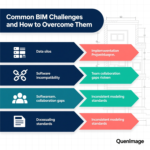
We address common hurdles in BIM implementation for infrastructure projects with proven strategies.
- Interoperability Issues: Resolved through open standards like IFC and USD, with cloud-based CDEs ensuring seamless data exchange.
- Skill Gaps: Overcome via comprehensive training programs, certifications, and partnerships with educational institutions.
- Initial Costs: Offset by long-term ROI from reduced rework (up to 40%), faster delivery, and cloud subscriptions minimizing upfront investments.
- Data Security: Managed rigorously per ISO 19650-5, with encrypted platforms and access controls.
Additional challenges like resistance to change are mitigated through pilot projects and demonstrated successes. Strategic phased implementation ensures smooth transitions, fostering cultural shifts toward digital collaboration in infrastructure projects.
Future Trends in BIM for Infrastructure
We anticipate transformative evolution in BIM driven by technology convergence through 2025 and beyond.
- Increased Automation: AI-guided robotic construction, generative design, and automated compliance checks.
- Sustainability Focus: Advanced carbon tracking, circular economy materials integration, and lifecycle emissions optimization.
- Connected Ecosystems: Full smart city interoperability with IoT, blockchain for data integrity, and ecosystem digital twins.
- Global Standardization: Wider ISO 19650 adoption, openBIM advancements, and regulatory mandates accelerating maturity.
Emerging trends include AI co-pilots for design, predictive twins for maintenance, and USD surpassing IFC for visualization. BIM for infrastructure projects will drive resilient, intelligent roads, bridges, and smart cities, with market projections to $22 billion by 2032.
Suggestions / Recommendations
We recommend adopting ISO 19650-compliant BIM processes from project inception, utilizing tools like Autodesk Civil 3D, InfraWorks, Bentley OpenRoads, and OpenBridge for roads and bridges. Prioritize comprehensive training, early GIS integration for smart city alignment, regular clash detections, AI-enhanced simulations, and digital twin development for long-term asset management. Partner with experienced BIM providers, conduct pilot implementations, and leverage cloud platforms for interoperability in complex infrastructure projects. Focus on sustainability metrics and predictive analytics to maximize efficiency and resilience.
FAQs
- What is BIM for infrastructure projects? We define it as intelligent 3D modeling for planning and managing roads, bridges, and related assets.
- How does BIM benefit road design? It enhances accuracy, clash detection, and traffic simulation.
- What role does BIM play in bridge construction? It supports structural analysis, sequencing, and prefabrication.
- How is BIM used in smart cities? It creates digital twins for urban planning and resource optimization.
- What is ISO 19650? An international standard for BIM information management.
- Can BIM reduce costs in infrastructure? Yes, through error reduction and efficient quantity takeoffs.
- What tools are common for BIM in roads? Autodesk Civil 3D and InfraWorks.
- How does BIM improve sustainability? Via energy simulations and material optimization.
- What are digital twins in BIM? Real-time virtual replicas for monitoring.
- Is BIM mandatory for public projects? Increasingly, especially in regions adopting ISO 19650.
- How does GIS integrate with BIM? For geospatial context in smart cities.
- What challenges exist in BIM for bridges? Complex geometries, addressed via parametric modeling.
- Can BIM support predictive maintenance? Yes, with IoT sensor integration.
- What are examples of BIM in smart cities? Songdo, South Korea, using integrated modeling.
- Why choose BIM for infrastructure? For collaboration, efficiency, and lifecycle management.