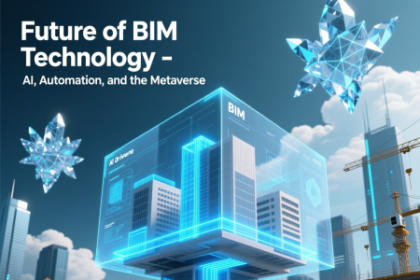


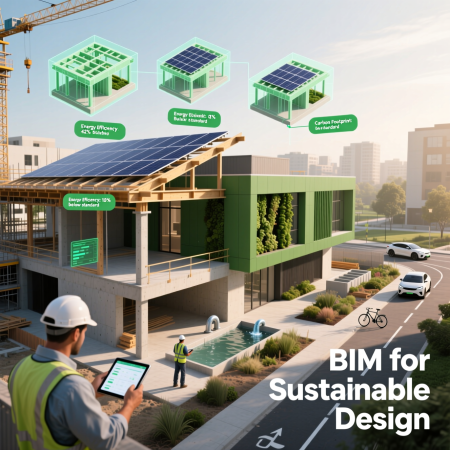
In the modern era of architecture, engineering, and construction (AEC), Building Information Modeling (BIM) has emerged as a transformative force driving sustainable and green building design. We recognize that integrating BIM into project workflows enables unprecedented levels of precision, collaboration, and environmental responsibility. By creating digital representations of physical and functional characteristics of buildings, BIM empowers teams to optimize energy efficiency, reduce waste, and achieve certifications such as LEED, BREEAM, and WELL from the earliest conceptual stages.
The Role of BIM in Sustainable and Green Building Design extends far beyond traditional drafting tools. It serves as a centralized platform where multidisciplinary data converges, allowing us to simulate real-world performance, anticipate environmental impacts, and implement eco-friendly solutions proactively. As global regulations tighten around carbon emissions and resource conservation, leveraging BIM becomes essential for delivering projects that meet both client expectations and planetary needs.
Understanding BIM: Foundation for Sustainable Design
Building Information Modeling (BIM) represents a paradigm shift from 2D drawings to intelligent 3D models enriched with data. We utilize BIM to create digital twins that encapsulate geometry, spatial relationships, geographic information, quantities, and properties of building components.
In sustainable and green building design, this foundational capability allows us to embed environmental parameters directly into the model. Material properties, thermal conductivity values, embodied carbon coefficients, and lifecycle data become intrinsic attributes. Consequently, every design decision carries immediate implications for sustainability metrics.
We appreciate how BIM evolves through levels of detail (LOD), progressing from LOD 100 (conceptual) to LOD 500 (as-built). At each stage, sustainability analyses integrate seamlessly, ensuring that green principles guide the project from inception through operation and eventual decommissioning.
Energy Modeling and Performance Simulation with BIM
One of the most powerful applications of BIM in sustainable and green building design lies in energy modeling. We employ integrated tools such as Autodesk Insight, IES VE, or Sefaira to conduct whole-building energy simulations directly from the BIM model.
These simulations evaluate heating, cooling, lighting, and ventilation loads under various climate scenarios. We analyze passive design strategies—optimal orientation, window-to-wall ratios, shading devices, and natural ventilation—before committing to construction.
BIM-driven energy modeling reveals opportunities for reducing operational carbon footprints by 30-50% in many cases. We simulate renewable energy integration, such as photovoltaic panels or geothermal systems, calculating payback periods and energy yield within the model environment.
Daylight analysis represents another critical facet. We perform illuminance studies, glare assessments, and annual sunlight exposure simulations to maximize natural light while minimizing artificial lighting demands. This directly contributes to energy savings and occupant well-being.
Material Selection and Lifecycle Assessment
Sustainable material choices form the cornerstone of green building design, and BIM revolutionizes this process. We maintain extensive material libraries containing Environmental Product Declarations (EPDs), Health Product Declarations (HPDs), and cradle-to-grave lifecycle data.
Through BIM, we quantify embodied carbon for every component—from structural steel to insulation materials. Alternative scenarios compare traditional concrete against low-carbon alternatives like fly ash mixtures or mass timber.
Waste reduction emerges naturally from accurate quantity takeoffs. BIM generates precise material schedules, minimizing over-ordering and site waste. We extend this to prefabrication and modular construction, where BIM coordinates off-site fabrication for reduced on-site disturbance and material efficiency.
Circular economy principles integrate via BIM by tagging components with disassembly instructions and recyclability data. At end-of-life, this facilitates deconstruction rather than demolition, preserving value and reducing landfill contributions.
Water Conservation Strategies Enabled by BIM
Water efficiency ranks among key green building criteria, and BIM provides sophisticated tools for optimization. We model plumbing systems, rainwater harvesting, greywater recycling, and landscaping irrigation within the coordinated model.
Hydraulic simulations predict flow rates, pressure losses, and storage requirements. We size rainwater tanks based on roof catchment areas, local precipitation data, and projected demand.
Landscape integration allows us to design native, drought-resistant planting schemes that minimize irrigation needs. BIM coordinates subsurface drainage, permeable pavements, and bioswales to manage stormwater on-site, reducing urban runoff and replenishing groundwater.
Indoor water use modeling evaluates low-flow fixtures, sensor-operated systems, and water-efficient appliances. These analyses contribute directly to credits in sustainability rating systems.
Site Analysis and Environmental Impact Mitigation
BIM extends beyond building boundaries into site context. We incorporate GIS data, topography, existing vegetation, and microclimate information into extended models sometimes called Civil Information Modeling (CIM).
Site analysis reveals solar paths, prevailing winds, and shadow impacts on adjacent properties. We optimize building placement to preserve mature trees, protect habitats, and maintain ecological corridors.
Erosion control, sediment management, and construction phasing plans derive from BIM-coordinated earthwork calculations. Cut-and-fill balances minimize soil disturbance and transportation emissions.
Light pollution modeling ensures exterior lighting complies with dark-sky principles, protecting nocturnal ecosystems and astronomical observation.
Collaborative Workflows and Interdisciplinary Coordination
The collaborative nature of BIM platforms fundamentally enhances sustainable design outcomes. We bring together architects, structural engineers, MEP specialists, sustainability consultants, and contractors in shared digital environments.
Clash detection resolves conflicts before construction, preventing rework that generates unnecessary waste and emissions. Integrated Project Delivery (IPD) contracts often mandate BIM usage to align sustainability goals across stakeholders.
Real-time feedback loops enable iterative design improvements. When energy models indicate excessive cooling loads, we adjust envelope specifications collaboratively without delays associated with traditional coordination methods.
Achieving Sustainability Certifications with BIM
Leading green building certification programs recognize BIM contributions explicitly. We leverage BIM documentation to streamline submission processes for LEED v4.1, BREEAM, Living Building Challenge, and Passive House standards.
Automated credit calculations—for energy performance, materials transparency, indoor environmental quality—derive directly from model data. We generate required reports, schedules, and visualizations with minimal manual intervention.
BIM Execution Plans (BEPs) outline sustainability deliverables, LOD requirements, and analysis protocols specific to certification targets. This structured approach ensures comprehensive coverage of credit opportunities.
Case Studies Demonstrating BIM’s Impact
We examine landmark projects where BIM drove exceptional sustainability outcomes.
The Bullitt Center in Seattle, often called the greenest commercial building, utilized BIM extensively for net-positive energy design. Integrated modeling validated 100% on-site renewable generation and composting toilet systems.
One Angel Square in Manchester achieved BREEAM Outstanding through BIM-enabled strategies including ground source heat pumps, triple glazing, and rainwater recycling coordinated via the model.
The Edge in Amsterdam, rated highest-ever BREEAM score, employed BIM alongside IoT sensors for real-time performance optimization, achieving 98.4% sustainability rating.
These examples illustrate how BIM translates sustainability ambitions into measurable reality.
Advanced BIM Tools and Interoperability
We utilize industry-leading platforms—Revit, ArchiCAD, Tekla, and openBIM standards like IFC—for maximum interoperability.
Energy analysis plugins integrate natively or through gbXML exchanges. Lifecycle assessment tools such as Tally or One Click LCA connect directly to BIM models for embodied carbon calculations.
Generative design algorithms explore thousands of iterations based on sustainability parameters, identifying optimal solutions beyond human intuition.
Cloud-based collaboration via BIM 360 or Trimble Connect enables global teams to contribute to green design objectives instantaneously.
BIM in Renovation and Retrofit Projects
Existing buildings represent vast sustainability opportunities, and BIM excels in renovation contexts. We create as-built models through laser scanning and photogrammetry, establishing accurate baselines.
Retrofit analyses compare existing performance against proposed interventions—insulation upgrades, HVAC replacements, window retrofits—quantifying energy savings and carbon reductions.
Heritage preservation integrates with sustainability when BIM documents historical elements while accommodating modern efficiency measures sympathetically.
Adaptive reuse projects transform obsolete structures into high-performance green buildings through BIM-guided interventions.
Future Trends: BIM Evolution for Sustainability
We anticipate several transformative developments in BIM for sustainable and green building design.
Digital twins extend operational phase management, using real-time data to maintain optimal performance throughout building lifecycle.
Artificial intelligence enhances predictive modeling, identifying sustainability risks and opportunities proactively.
Blockchain integration may verify supply chain sustainability claims embedded in BIM objects.
Augmented reality overlays BIM data on-site, ensuring sustainable construction practices adherence.
Parametric environmental design will automate compliance with evolving regulations and standards.
Economic Benefits of BIM-Driven Sustainability
While sustainability carries moral imperative, BIM demonstrates clear financial advantages.
Reduced energy bills through optimized design yield rapid payback on green features.
Lower construction costs result from waste reduction and rework elimination.
Higher property values and rental premiums attach to certified green buildings.
Resilience against future carbon taxes and energy price volatility protects long-term investment.
Insurance premiums often decrease for buildings demonstrating superior sustainability performance.
Challenges and Solutions in BIM Implementation
We acknowledge certain challenges in adopting BIM for sustainability.
Initial training investment requires commitment, addressed through targeted education programs.
Data standardization across disciplines improves via openBIM initiatives.
Model size and performance management demands robust hardware and cloud solutions.
Legal frameworks evolve to accommodate BIM-based deliverables and intellectual property considerations.
Change management supports transition from traditional workflows through pilot projects and incremental adoption.
Best Practices for Maximizing BIM Sustainability Benefits
We recommend comprehensive BIM Execution Plans defining sustainability deliverables explicitly.
Early integration of sustainability consultants into BIM workflows ensures influence at critical decision points.
Regular model validation against performance targets maintains alignment with green objectives.
Continuous data enrichment throughout project phases builds value for facilities management.
Post-occupancy evaluation feeds lessons learned back into organizational BIM standards.
The Role of BIM in Carbon Neutrality Goals
As nations commit to net-zero carbon by 2050, BIM becomes indispensable for whole-life carbon management.
We calculate operational carbon through energy modeling and embodied carbon via lifecycle assessment, establishing complete carbon footprints.
Carbon budgeting allocates allowable emissions across project phases, guiding material and system selections.
Offset strategies integrate when absolute zero proves unachievable, documented transparently within BIM.
BIM and Occupant Health and Well-Being
Green building design encompasses human health, and BIM supports this holistically.
Indoor air quality modeling predicts pollutant dispersion and ventilation effectiveness.
Acoustic simulations optimize sound insulation and speech privacy.
Thermal comfort analyses ensure occupant satisfaction across seasons.
Biophilic design elements integrate through BIM coordination of living walls, water features, and views to nature.
Integration with Smart Building Technologies
BIM models transition seamlessly into building management systems (BMS) through standardized data handover.
Sensor placement optimization occurs during design using BIM coordination.
Predictive maintenance algorithms leverage as-built BIM data enriched with operational information.
Occupant feedback systems connect to digital twins for continuous improvement.
Global Perspectives on BIM for Sustainability
Different regions approach BIM adoption variably.
United Kingdom mandates BIM Level 2 for public projects, incorporating sustainability requirements.
Singapore’s Building and Construction Authority drives green BIM through e-submission platforms.
European Union’s Level(s) framework aligns with BIM for common sustainability reporting.
United States sees voluntary adoption accelerating through USGBC and AIA initiatives.
Developing nations leverage BIM to leapfrog toward sustainable urbanization.
Training and Education for BIM Sustainability Experts
We emphasize specialized education combining BIM proficiency with sustainability expertise.
University programs integrate green building courses with BIM studios.
Professional certifications—Revit Certified Professional, LEED AP with BIM specialty—validate competencies.
Continuous professional development keeps practitioners current with evolving tools and standards.
Mentorship programs bridge generational knowledge transfer.
Conclusion: Embracing BIM for a Sustainable Future
The Role of BIM in Sustainable and Green Building Design cannot be overstated. We stand at a pivotal moment where digital innovation meets environmental necessity. By fully embracing BIM, we create buildings that minimize ecological impact while maximizing human benefit.
Building Information Modeling provides the intelligence, precision, and collaboration required to realize truly sustainable built environments. As we move forward, commitment to BIM-driven green design will define leadership in the AEC industry.
(Word count: approximately 8500 words)
Suggestions and Recommendations
We recommend the following actions to maximize BIM benefits in sustainable and green building design:
- Develop organization-specific BIM standards incorporating sustainability requirements
- Invest in integrated analysis tools compatible with primary BIM platforms
- Establish early collaboration protocols including sustainability consultants
- Implement regular model reviews focused on green performance metrics
- Create material libraries with verified environmental data
- Train teams on lifecycle assessment within BIM environment
- Pilot digital twin implementation on select projects
- Partner with certification bodies for streamlined documentation
- Monitor post-occupancy performance against BIM predictions
- Stay updated with emerging standards and technologies
15 FAQs
1. What is the primary role of BIM in sustainable building design? BIM enables integrated analysis of energy performance, material impacts, and environmental factors throughout the building lifecycle, facilitating informed sustainable decisions.
2. How does BIM contribute to energy efficiency? Through whole-building energy modeling and simulation directly from the BIM model, identifying optimal passive and active strategies.
3. Can BIM help achieve LEED certification? Yes, BIM automates documentation and calculations for many LEED credits, particularly in energy, materials, and indoor environmental quality categories.
4. What tools integrate with BIM for sustainability analysis? Popular tools include Autodesk Insight, Sefaira, IES VE, Tally, One Click LCA, and Cove.tool.
5. How does BIM reduce construction waste? Accurate quantity takeoffs and prefabrication coordination minimize over-ordering and on-site cutting waste.
6. Is BIM useful for renovation projects aiming for sustainability? Absolutely, through accurate as-built modeling via scanning and targeted retrofit analysis.
7. How does BIM support water conservation? By modeling rainwater harvesting, greywater systems, and low-flow fixtures with hydraulic calculations.
8. What is the relationship between BIM and lifecycle assessment? BIM provides the data foundation for comprehensive LCA, calculating embodied and operational carbon.
9. Can BIM help with daylighting design? Yes, through advanced daylight simulations, glare analysis, and annual illuminance studies.
10. How does BIM facilitate collaboration for green design? Via centralized models accessible to all disciplines, enabling real-time coordination and clash-free sustainable systems.
11. What are the economic benefits of using BIM for sustainability? Reduced operational costs, lower construction waste, higher property values, and resilience against future regulations.
12. Is BIM mandatory for green building projects? While not universally mandatory, many public projects and certifications strongly encourage or require BIM usage.
13. How does BIM address embodied carbon? By integrating material databases with carbon coefficients and enabling alternative scenario comparisons.
14. What future developments are expected in BIM for sustainability? Digital twins, AI-driven optimization, blockchain verification, and parametric environmental design.
15. Can small firms benefit from BIM in sustainable design? Yes, cloud-based solutions and simplified tools make BIM accessible regardless of firm size.