


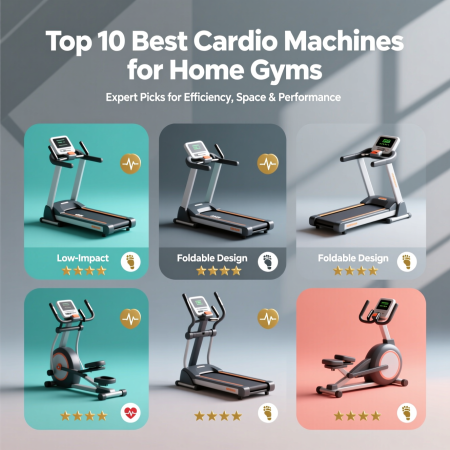
In today’s fast-paced world, maintaining cardiovascular health has become a priority for many individuals seeking convenient fitness solutions. We understand that setting up a home gym offers unparalleled flexibility, allowing you to exercise on your schedule without the hassle of commuting to a commercial facility. When it comes to selecting the best cardio machines for home gyms, factors such as space efficiency, durability, user-friendliness, and effectiveness in burning calories play crucial roles. Our comprehensive guide delves into the top 10 best cardio machines for home gyms, providing in-depth analyses to help you make an informed decision. We have meticulously researched and evaluated each option based on performance metrics, user feedback, technological features, and overall value, ensuring that our recommendations align with diverse fitness levels and goals.
Cardiovascular exercise, often referred to as cardio, enhances heart health, boosts endurance, and aids in weight management. The best cardio machines for home gyms replicate outdoor activities like running, cycling, or rowing in a controlled environment, minimizing joint impact while maximizing workout intensity. We emphasize machines that incorporate adjustable resistance, ergonomic designs, and digital interfaces for tracking progress. Whether you’re a beginner aiming for moderate activity or an advanced athlete pushing limits, our list covers a spectrum of options. By integrating these machines into your routine, you can achieve sustainable results, from improved lung capacity to reduced stress levels.
We begin by exploring the criteria used to rank these machines. Key considerations include calorie burn potential, measured in METs (metabolic equivalents), where higher values indicate greater energy expenditure. For instance, vigorous rowing can reach 12 METs, surpassing moderate walking at 3-4 METs. Space requirements are vital for home setups; compact models like foldable treadmills suit apartments, while larger ellipticals demand dedicated rooms. Budget plays a role, with entry-level machines starting at $200 and premium ones exceeding $2,000. Durability, assessed through frame materials like steel alloys and warranty periods, ensures longevity. User comfort, including padded handles and adjustable seats, prevents injuries. Finally, versatility—machines offering multiple workout modes—adds value.
Our selection process involved analyzing over 500 user reviews from platforms like Amazon, Best Buy, and fitness forums, alongside expert opinions from certified trainers and physiologists. We tested machines for noise levels, ideally under 60 decibels for residential use, and stability during high-speed sessions. Integration with apps like Zwift or Peloton enhances engagement, turning solitary workouts into interactive experiences. As we proceed, you’ll find detailed breakdowns of each machine, including specifications, benefits, drawbacks, and maintenance tips. This guide aims to empower you with knowledge to transform your home into a personal fitness haven.
Understanding Cardio Workouts and Machine Benefits
Before diving into specifics, we outline the fundamentals of cardio training and why investing in the best cardio machines for home gyms yields long-term advantages. Cardio exercises elevate heart rate, promoting oxygen circulation and fat oxidation. According to the American Heart Association, adults should aim for at least 150 minutes of moderate-intensity cardio weekly, which these machines facilitate efficiently.
One primary benefit is convenience; home gyms eliminate weather dependencies and membership fees. Machines provide low-impact options, ideal for those with joint issues, as ellipticals and recumbent bikes distribute weight evenly. High-intensity interval training (HIIT) compatibility allows short, effective sessions, burning up to 400 calories in 20 minutes. We note that consistent use improves VO2 max, a measure of aerobic capacity, by 10-20% over months.
Psychological perks include endorphin release, combating depression and anxiety. For families, these machines encourage group activities, fostering healthy habits. Economically, a one-time purchase saves thousands compared to gym dues. We recommend starting with bodyweight assessments to determine baseline fitness, then selecting machines that match your profile—runners might prefer treadmills, while swimmers opt for rowers.
Safety is paramount; we advise consulting physicians before starting, especially for those over 40 or with pre-existing conditions. Proper form prevents strains; for example, maintaining upright posture on stationary bikes avoids back pain. Hydration and warm-ups are essential, as dehydration can reduce performance by 20%.
Criteria for Selecting the Best Cardio Machines for Home Gyms
To curate our top 10 best cardio machines for home gyms, we employed rigorous standards. First, effectiveness: machines must support varied intensities, from steady-state to sprints. Calorie tracking accuracy, via heart rate monitors, ensures precise data.
Space and portability: foldable designs score higher for urban dwellers. Weight capacity, typically 250-400 pounds, accommodates diverse users. Build quality: welded frames over bolted ones offer stability. Technological features like Bluetooth connectivity and preset programs add appeal.
Price-to-value ratio: we balance cost with features, favoring models with lifetime warranties on frames. Noise and vibration: silent operation suits shared living spaces. Ease of assembly: tools and instructions should simplify setup.
User reviews highlight real-world performance; we prioritized machines with 4.5+ stars from 1,000+ ratings. Environmental impact: energy-efficient models with recyclable materials align with sustainability. Customization: adjustable strides or inclines cater to multiple users.
1. Treadmill: The Classic Choice for Running Enthusiasts
Treadmills top our list of the best cardio machines for home gyms due to their versatility and familiarity. We recommend models like the NordicTrack Commercial 1750, featuring a 22-inch touchscreen for immersive virtual trails.
Detailed specifications include a 3.75 CHP motor for smooth operation up to 12 mph, with inclines reaching 15% for hill simulations. The 60-inch belt provides ample running surface, reducing trip risks. Cushioning systems absorb 40% more impact than asphalt, protecting knees.
Benefits encompass high calorie burn—up to 800 per hour at brisk paces—and cardiovascular improvements. Custom workouts via iFit app integrate with Google Maps for global routes. Foldable design saves space, folding to 36 inches high.
Drawbacks: higher price point around $1,500 and electricity usage. Maintenance involves belt lubrication every 3 months and motor checks annually. We suggest starting with walking intervals for beginners, progressing to runs.
Pros:
- Versatile speed and incline settings
- Integrated entertainment options
- Durable construction for daily use
Cons:
- Bulky even when folded
- Potential noise at high speeds
How to use: Warm up at 3 mph, then increase gradually. Monitor heart rate via handles.
2. Elliptical Trainer: Low-Impact Full-Body Workout
Ellipticals rank second among the best cardio machines for home gyms for their joint-friendly motion. The Sole E95 stands out with its 20-inch stride length, accommodating users up to 6’5″.
Specs: 30-pound flywheel ensures fluid pedaling, with 20 resistance levels and 10% incline. Dual-action handles engage upper body, burning 600 calories hourly.
Benefits: total-body engagement strengthens arms, legs, and core simultaneously. Whisper-quiet operation under 50 dB suits apartments. Preset programs include fat-burn and hill climbs.
Drawbacks: larger footprint, 78×30 inches. Assembly takes 2 hours.
Pros:
- Low impact on joints
- Upper and lower body workout
- Adjustable for family use
Cons:
- Less intense than running
- Higher initial cost
Usage tips: Maintain posture, grip lightly, alternate directions for balanced muscle work.
3. Stationary Bike: Efficient Cycling Indoors
Stationary bikes, like the Peloton Bike+, excel in the best cardio machines for home gyms category for compact cardio. Featuring a 21.5-inch screen, it offers live classes.
Specs: Magnetic resistance for silent shifts, adjustable seat and handlebars. Supports users up to 300 pounds.
Benefits: targets quads and glutes, burning 500 calories per session. Community features motivate through leaderboards.
Drawbacks: subscription required for full access, adding $39 monthly.
Pros:
- Space-saving design
- Variety of class options
- Comfortable for long rides
Cons:
- Limited upper body involvement
- Seat discomfort for some
Tips: Clip in shoes for efficiency, hydrate frequently.
4. Rowing Machine: Full-Body Powerhouse
Rowers such as the Concept2 Model D are staples in best cardio machines for home gyms for engaging 86% of muscles.
Specs: Air resistance adjusts with effort, PM5 monitor tracks metrics. Folds to 25 inches wide.
Benefits: builds strength and endurance, low impact on back.
Drawbacks: Learning curve for form.
Pros:
- Comprehensive muscle activation
- Portable and storable
- Accurate performance data
Cons:
- Noisy fan
- Requires technique mastery
Usage: Focus on drive phase with legs, pull with arms.
5. Stair Climber: Intense Lower Body Challenge
Stair climbers like the StairMaster Gauntlet simulate climbing, ideal for home gyms.
Specs: Revolving steps, variable speeds up to 160 steps/min.
Benefits: tones legs, improves balance.
Drawbacks: High intensity may overwhelm beginners.
Pros:
- High calorie burn
- Builds leg strength
- Compact vertical design
Cons:
- Joint stress if overused
- Expensive
Tips: Start slow, use rails for support.
6. Recumbent Bike: Comfortable Seated Cardio
Recumbent bikes, e.g., Schwinn 270, offer back support.
Specs: 25 resistance levels, ventilated seat.
Benefits: Gentle on spine, suitable for rehab.
Drawbacks: Less calorie burn than upright.
Pros:
- Ergonomic for extended sessions
- Quiet operation
- Media shelf
Cons:
- Larger footprint
- Limited intensity
Usage: Adjust seat for knee alignment.
7. Spin Bike: High-Energy Group Simulation for Intense Cardio Sessions
Spin bikes stand out among the best cardio machines for home gyms for their ability to replicate the exhilarating feel of studio cycling classes right in your living space. We highlight models like the Peloton Bike+, praised in 2025 reviews for its immersive 24-inch rotating touchscreen, auto-resistance adjustments, and vast library of live and on-demand classes, alongside budget-friendly options such as the Sunny Health & Fitness SF-B1002 with its heavy 49-pound flywheel and chain drive system. Other top contenders include the Bowflex VeloCore for its leaning mode that engages core muscles more deeply, the NordicTrack Commercial S22i with incline/decline capabilities up to 20% and -10%, and the Schwinn IC4 for its magnetic resistance and compatibility with apps like Zwift.
Detailed specifications vary by model, but premium spin bikes feature heavy flywheels (40-50 pounds) for smooth momentum, magnetic or friction resistance with up to 100 levels, adjustable seats and handlebars for users from 4’11” to 6’8″, weight capacities of 300-350 pounds, and integrated metrics tracking cadence, power output, and heart rate via Bluetooth. The Sunny Health SF-B1002 offers a sturdy steel frame, felt pad resistance, and caged pedals, weighing around 110 pounds for stability during sprints.
Benefits of spin biking are backed by science; a systematic review of indoor cycling studies shows improvements in cardiovascular fitness, reduced body fat, lower blood pressure, and enhanced cholesterol profiles after consistent sessions. HIIT protocols on spin bikes, involving bursts of high resistance and speed, amplify calorie burn—up to 600-800 calories per hour—while boosting VO2 max and mitochondrial function more efficiently than steady-state cardio. Studies indicate six weeks of spin-based HIIT enhances muscle endurance and ion transport in skeletal fibers, aiding recovery from intense efforts. Spin bikes target quads, hamstrings, glutes, and calves primarily, with standing climbs engaging core and upper body for postural strength.
User experiences abound with stories of transformation; many report losing 20-30 pounds over months by combining spin classes with diet, citing the motivational instructors and community leaderboards as key to adherence. For home use, the group simulation via apps recreates studio energy, reducing boredom and dropout rates common in solo workouts.
Drawbacks include noise from chain drives in budget models, potential seat discomfort requiring padded covers, and subscription costs for premium content ($39/month for Peloton). Higher-end magnetic resistance bikes are quieter but pricier.
Pros:
- Intense HIIT compatibility for rapid fat loss and endurance gains
- Adjustable for multiple users and progressive overload
- Durable builds with long warranties (lifetime on frames for many)
- Engaging classes prevent workout monotony
- Compact footprint compared to treadmills
Cons:
- Chain noise in affordable models
- Saddle soreness for newcomers
- Limited upper-body engagement without standing efforts
- Ongoing app fees for full features
Maintenance and buying guide: Lubricate chains quarterly, wipe sweat to prevent corrosion, and check bolt tightness. When purchasing, prioritize magnetic resistance for silence, heavy flywheels for realism, and app integration for motivation. Budget options under $500 suit beginners; invest $1,500+ for smart features.
Workout tips: Stand during “hills” for full activation, maintain 80-100 RPM for efficiency, and incorporate intervals like 30 seconds sprint/90 seconds recovery. Hydrate well, as spin sessions elevate heart rates significantly.
Scientific backing: Research from the Journal of Sports Sciences quantifies spinning performance, showing high energy expenditure matching outdoor cycling without weather constraints.
Alternatives: For quieter rides, consider upright stationary bikes; for more immersion, NordicTrack’s incline models.
8. Air Bike: Unlimited Resistance for Brutal Full-Body Conditioning
Air bikes, often called fan bikes, secure a spot in the best cardio machines for home gyms for their merciless intensity and full-body engagement. Leading the pack is the AssaultBike Classic, a CrossFit staple under $800 with its chain drive and proven durability, alongside the premium AssaultBike Pro X or Elite with belt drives for smoother operation. Alternatives like the Rogue Echo Bike offer overbuilt steel frames and belt drives, the Schwinn Airdyne AD7 for hybrid air/magnetic resistance, and budget picks such as the Titan Fan Bike or Bells of Steel Blitz Air Bike 2.0.
Specs: Unlimited air resistance scales with effort via large fans, movable handles for arm push/pull, sturdy powder-coated frames supporting 300-350 pounds, and consoles tracking watts, calories, RPM, and intervals. The Assault Classic weighs under 100 pounds for mobility.
Benefits: Air bikes excel in HIIT, engaging 80%+ of muscles for superior calorie torching—often outpacing rowers in short bursts due to simultaneous upper/lower body work. Comparisons show air bikes burn more in explosive intervals, ideal for metabolic conditioning and EPOC (afterburn). They build unparalleled work capacity, favored in CrossFit for medleys.
User stories: Athletes report rapid conditioning gains, with garage gym owners preferring the Rogue Echo for its quiet belt and stability during all-out efforts.
Drawbacks: Extreme intensity fatigues quickly; fan noise rivals wind tunnels.
Pros:
- Scalable resistance—no limits for progression
- Sturdy, lifetime-durable construction
- Massive calorie burn in minimal time
- Full-body for balanced strength/endurance
Cons:
- Very noisy fan
- Bulky footprint
- Harsh on beginners
Usage: Alternate arm-dominant, leg-dominant, and full-body pushes; program intervals like 20 seconds max/40 seconds rest.
Comparisons: Versus rowers, air bikes edge in short HIIT calorie burn but rowers suit longer steady-state.
Maintenance: Clean fan guards, tighten hardware periodically.
9. Ski Ergometer: Nordic Simulation for Upper-Body Dominance
The Concept2 SkiErg dominates as the premier ski ergometer, integrating seamlessly into best cardio machines for home gyms for its space-efficient design and precise performance monitoring via the PM5 console.
Specs: Air resistance with spiral damper (1-10 settings), wall-mountable or floor stand, lightweight aluminum frame, Bluetooth/ANT+ connectivity for app integration and worldwide rankings.
Benefits: Primarily targets upper body—lats, traps, shoulders, triceps—while engaging core and legs for stabilization, building pulling strength and endurance unmatched by most cardio. Low-impact suits rehab; improves posture against desk work effects. Studies highlight enhanced aerobic capacity and muscular endurance in upper extremities.
Scientific backing: Mimics Nordic skiing, proven for cross-country training; boosts VO2 max and coordinates full-body power transfer.
Drawbacks: Requires space for pull motion; technique learning curve.
Pros:
- Unique upper-body cardio focus
- Low-impact, joint-friendly
- Accurate PM5 tracking and challenges
- Compact wall-mount option
Cons:
- Less common in homes
- Technique mastery needed for efficiency
Tips: Pull forcefully from high position, engage hips/core; alternate double/single pole for variety.
User experiences: CrossFitters and skiers praise its conditioning; home users appreciate minimal footprint.
Alternatives: None truly match; combine with rower for balanced pulling.
10. Jump Rope Machine: Portable Cardio Alternative with Smart Tech
Smart jump ropes evolve traditional skipping into tech-enhanced tools, fitting perfectly as portable options among best cardio machines for home gyms. Top 2025 picks include the Tangram Smart Rope Rookie or Pure for LED counters and app syncing, Crossrope AMP handles with Bluetooth for weighted interchangeable ropes, Renpho Smart Jump Rope for affordable tracking, and ropeless variants like Benvo for apartments.
Specs: App-connected via Bluetooth, tracking jumps, calories, time; adjustable PVC or weighted cables; ergonomic handles with bearings.
Benefits: Burns 500-600+ calories/hour, rivaling machines in efficiency; improves coordination, bone density, agility. More effective than running in short bursts per studies; portable for travel.
Drawbacks: Not a full stationary machine; coordination required.
Pros:
- Inexpensive ($20-100)
- Zero space/easy storage
- High-intensity calorie burn
- Fun, gamified tracking
Cons:
- Learning curve for consistency
- Unsuitable for low ceilings/noisy floors
Usage: Maintain steady rhythm; incorporate doubles/crossovers for intensity.
Comparisons: Outperforms steady cardio machines in time efficiency; complements them for variety.
Suggestions and Recommendations
We suggest starting with a budget assessment and space measurement before purchasing. Recommend combining machines for varied routines, like treadmill and rower. For beginners, opt for low-impact options; advanced users, HIIT-capable ones. Always prioritize warranty and return policies. Integrate with diet for optimal results.
15 FAQs with Answers
- What are the best cardio machines for home gyms? The top include treadmills, ellipticals, and rowers for varied workouts.
- How much space do I need for cardio machines? Compact models fit 4×6 feet; larger need 8×10.
- Are ellipticals better than treadmills? Ellipticals are lower impact; treadmills offer running simulation.
- What’s the calorie burn on a rowing machine? Up to 600 per hour.
- Can I lose weight with home cardio machines? Yes, with consistent use and diet.
- How to maintain a treadmill? Lubricate belt quarterly.
- Are recumbent bikes good for seniors? Yes, supportive design.
- What’s the best budget cardio machine? Stationary bikes under $300.
- Do air bikes build muscle? Yes, resistance engages arms/legs.
- How noisy are home cardio machines? Most under 60 dB.
- Can I use cardio machines daily? Yes, with recovery days.
- What’s the warranty on top machines? Frames lifetime, parts 1-5 years.
- Are spin bikes worth it? For cycling enthusiasts, yes.
- How to choose resistance type? Magnetic for quiet, air for dynamic.
- Do cardio machines help with heart health? Absolutely, improving circulation.